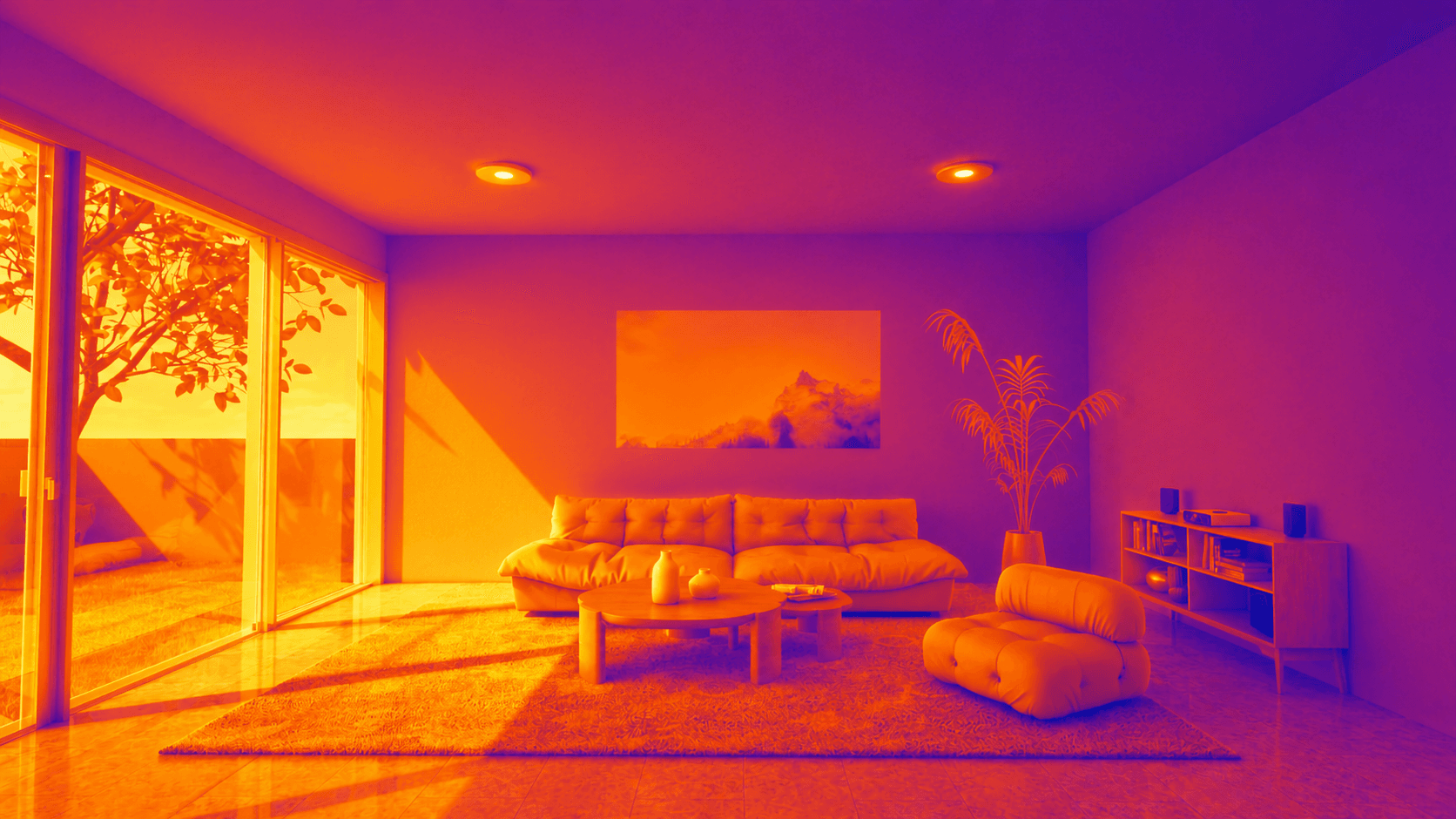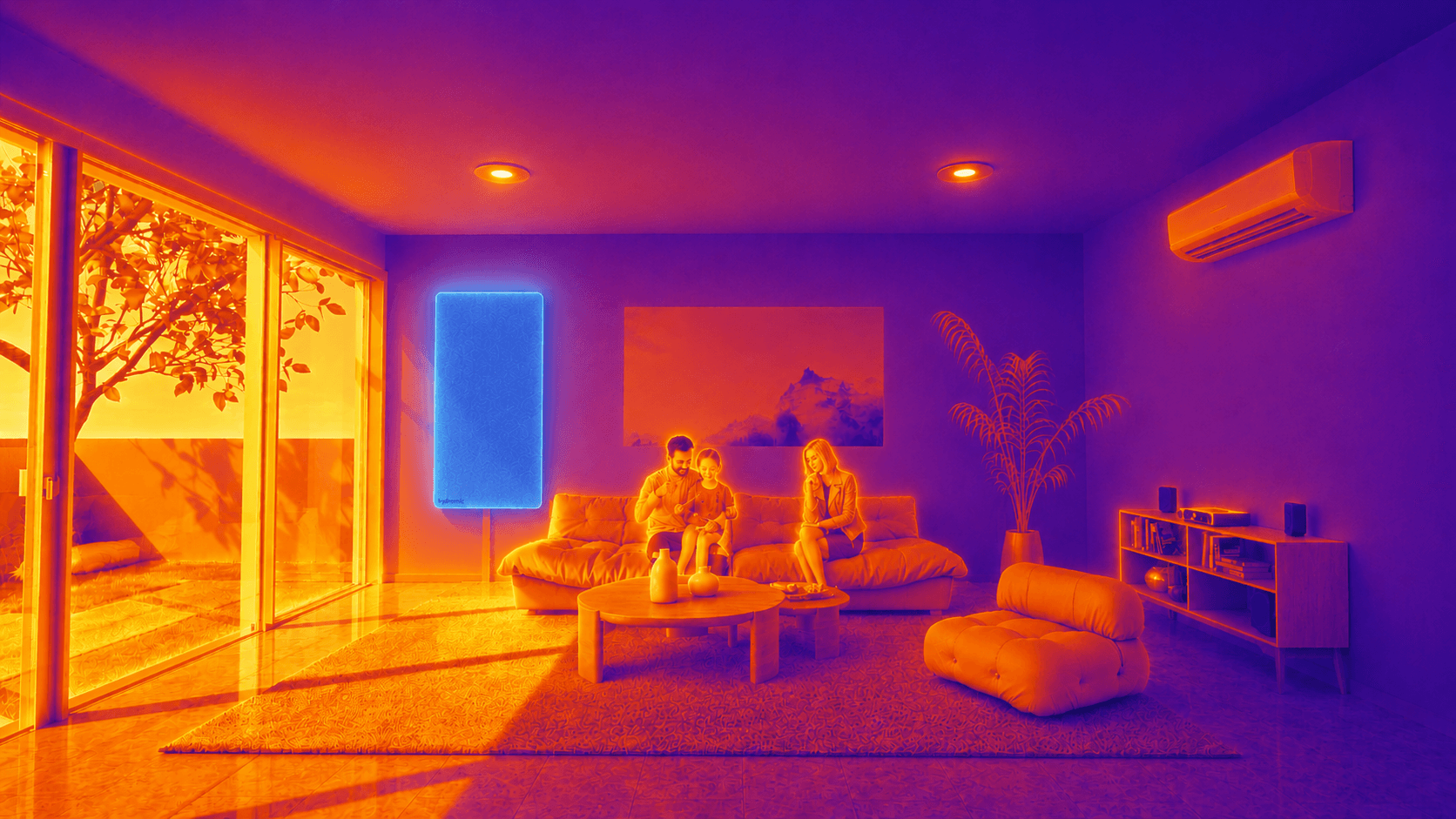

Intercept heat at the source.
Before it fills your room.
HydroPanel is a compact hydronic cooling panel that mounts where heat enters — removing multiples more heat per unit area than any distributed system.
The problem
Cooling demand is tripling. The grid can't absorb it.
1.6B → 5.6B
AC units by 2050 — one new unit sold every 3 seconds
>80%
Of demand growth is in emerging economies where grids are weakest
3×
Projected rise in AC electricity demand over the next 25 years
Air conditioning is thermodynamically mismatched.
Air carries ~3,400× less heat per volume than water. AC must move and chill an entire room's air mass — while surfaces keep radiating. Yet radiation accounts for ~45% of how the human body loses heat. The machine targets the wrong medium.
The better physics is locked behind renovation.
Hydronic radiant systems use water and address the right medium — independent research shows 17–42% cooling energy savings (LBNL) and 56.6% building energy savings with the right system (PNNL). But every radiant system conditions whole surfaces. For existing homes, that's unreachable.
The insight
Heat has quality, not just quantity.
It's highest right at the source.
Conventional systems act on heat after it has spread through the room and degraded to a room-average condition. Every watt looks the same at that stage.
But heat near its source is concentrated — the temperature gradient is steeper, the radiant field is stronger. In thermodynamic terms, it has higher exergy: the capacity to do useful work before dissipating.
A cool surface placed there works against that steeper gradient and removes more heat per unit area — before it ever becomes the diffuse, room-average load that AC must then fight.
Heat quality over space
High exergy — concentrated, steep gradient
Degrading — temperature differences narrowing
Low exergy — diffuse, hard to intercept efficiently
The shift in thinking
The room
Act on heat after it disperses
The source
Intercept heat while it's still concentrated
Experimental validation
Same panel. Same water.
Multiples more heat removed.
Two identical panels running off a single water supply — one at the heat source, one distributed. Measured across 3 room types and both heat-source categories under real occupancy.
Living room
6.1×
more heat removed per unit panel area
West-facing solar gain through glazing
15/17 sessions
Bedroom
2.9×
more heat removed per unit panel area
Mixed solar and occupancy gains
Consistent
Kitchen
7.2×
more heat removed per unit panel area
Appliance-generated internal heat
n=3 — indicative
What this proves: placement relative to the heat source is a first-order driver of panel performance. What this does not yet prove: room temperature change, comfort, or electricity savings — these are the next milestones.
88% win rate — 15 of 17 sessions
Why now
Refrigerants are being squeezed out. Grids are already buckling.
Regulation
The Kigali Amendment — 172 parties — is phasing down HFC refrigerants globally. The US AIM Act mandates an 85% cut by 2036. Water-based cooling sidesteps the refrigerant at the point of cooling.
Grid strain
Mexico's grid operator logged a record 52,945 MW summer peak in June 2025. The markets that need cooling most are the ones whose grids can afford it least.
Infrastructure
Heat pumps are mainstreaming low-temperature water loops into homes — the exact infrastructure a hydronic panel can connect to.
Demand
3.5 billion people live in hot regions at ~15% AC penetration. The next billion cooling units will go where HydroPanel is positioned.
Early access
Bring radiant efficiency to the homes
that were priced out.
HydroPanel is in early validation. Join the waitlist — early members get priority access and 3 months free at launch.